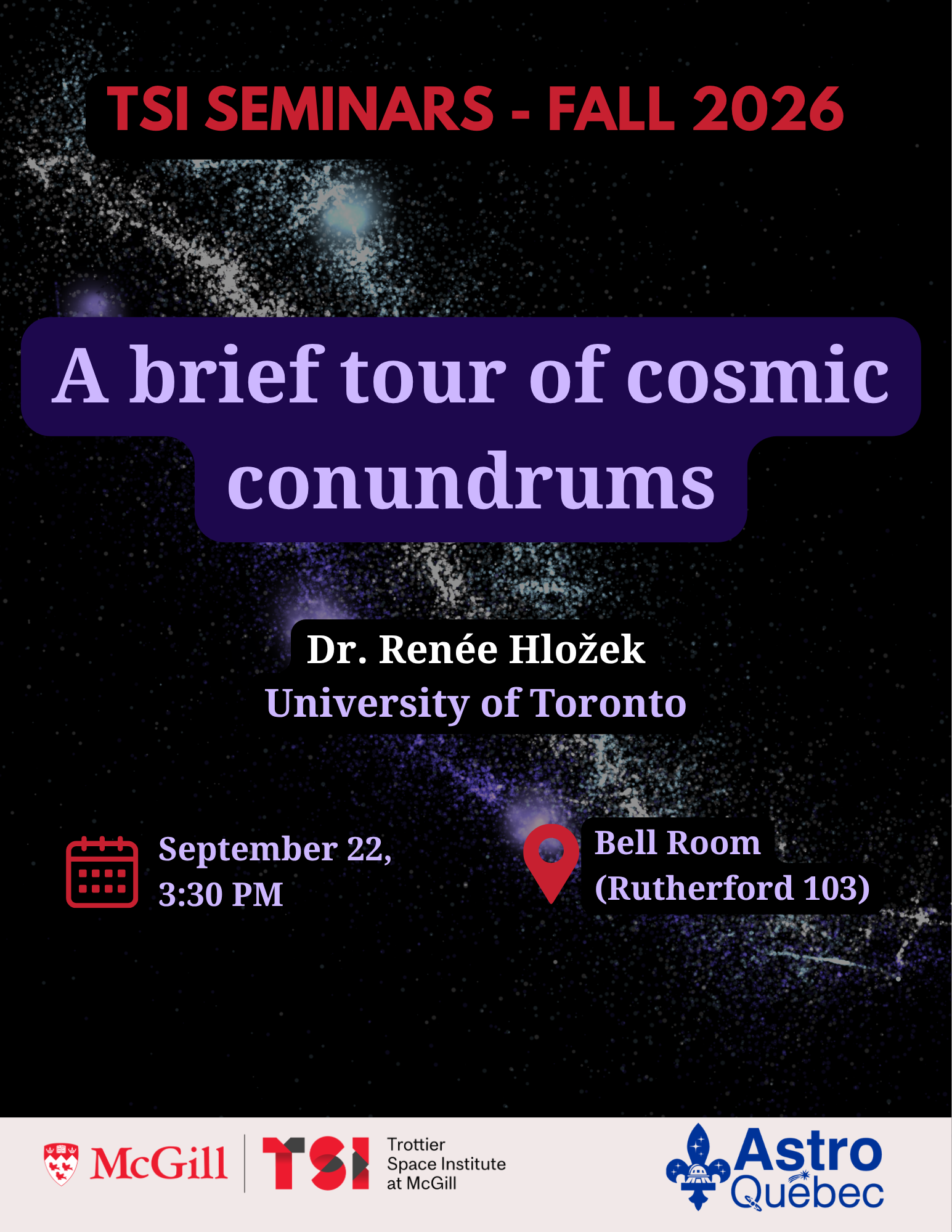
A brief tour of cosmic conundrums
Renée Hložek
(University of Toronto)
Sep 22, 2026 3:30 PM
to 4:30 PM
Location: Bell Room (Rutherford 103)
Seminar Event
The cosmos remains a dark and mysterious place. Surveys like CHIME continue to find a plethora of bright fast radio bursts (FRB) that continue to surprise us, as some FRB show repeat bursts while others do not. The collisionless cold dark matter (CDM) picture of the universe is extremely successful, however the clustering of matter on small scales suggests a more complicated picture. The universe is accelerating at late times, but does it do so driven by a 'cosmological constant' dark energy or something that varies across cosmic time? In my talk I will discuss a few recent papers that address some of these cosmic conundrums. I will present a machine-learning-driven study of FRB morphology and attempts at learning about FRB repeatability (2607.13148). I will highlight our attempts to novel probes to constrain axion dark matter (2602.22990 and 2502.03522). Finally I will discuss a result that is "hot off the press" where we discuss cosmological model comparison and motivate the need for robust statistical tools for questions as important as whether or not the cosmic acceleration has a redshift-dependence or not (2609.04334).
More
about Renée Hložek
⇒