The Radio Sky in Sync: Coherence, Maser Flares, and Superradiant Bursts
Fereshteh Rajabi
(McMaster University)
Sep 29, 2026 3:30 PM
to 4:30 PM
Location: Bell Room (Rutherford 103)
Seminar Event
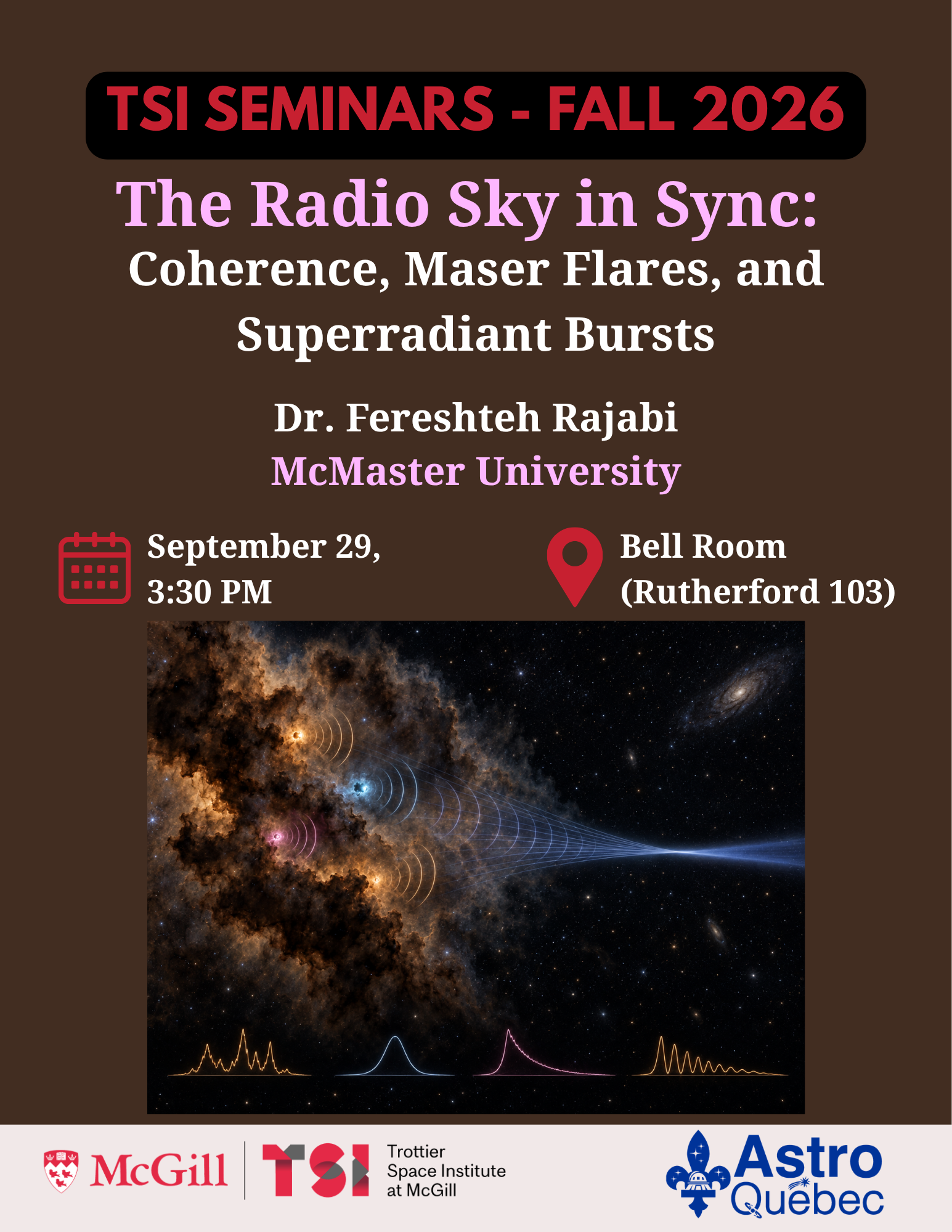
Some astronomical maser flares brighten by factors of hundreds or even thousands, with their radio emission rising much faster than changes in the pump-the energy input that maintains the conditions for maser emission. In a quasi-steady maser, the flare generally follows the pump in shape and duration. Dicke superradiance offers a fast-transient alternative based on phase coherence: through their shared radiation field, many molecules develop coordinated emission and release their stored energy collectively as a rapid, intense burst.
Using the Maxwell–Bloch equations, I will show how nonlinear feedback between matter and radiation connects familiar maser amplification to fast-transient superradiance. I will discuss applications to methanol, water, and OH emission and show how this framework can account for a range of flare morphologies, from nearly symmetric pulses and sharp-rise/slow-decay bursts to periodic flares, multiple peaks, and ringing. The observed light curve need not simply copy the pump: similar pumping can produce different delays, durations, and profiles because the flare reflects the dynamical response of the emitting gas. More broadly, coherence and nonlinearity can transform a modest or slowly varying change in the pump into a rapid and exceptionally bright radio burst.
More
about Fereshteh Rajabi
⇒