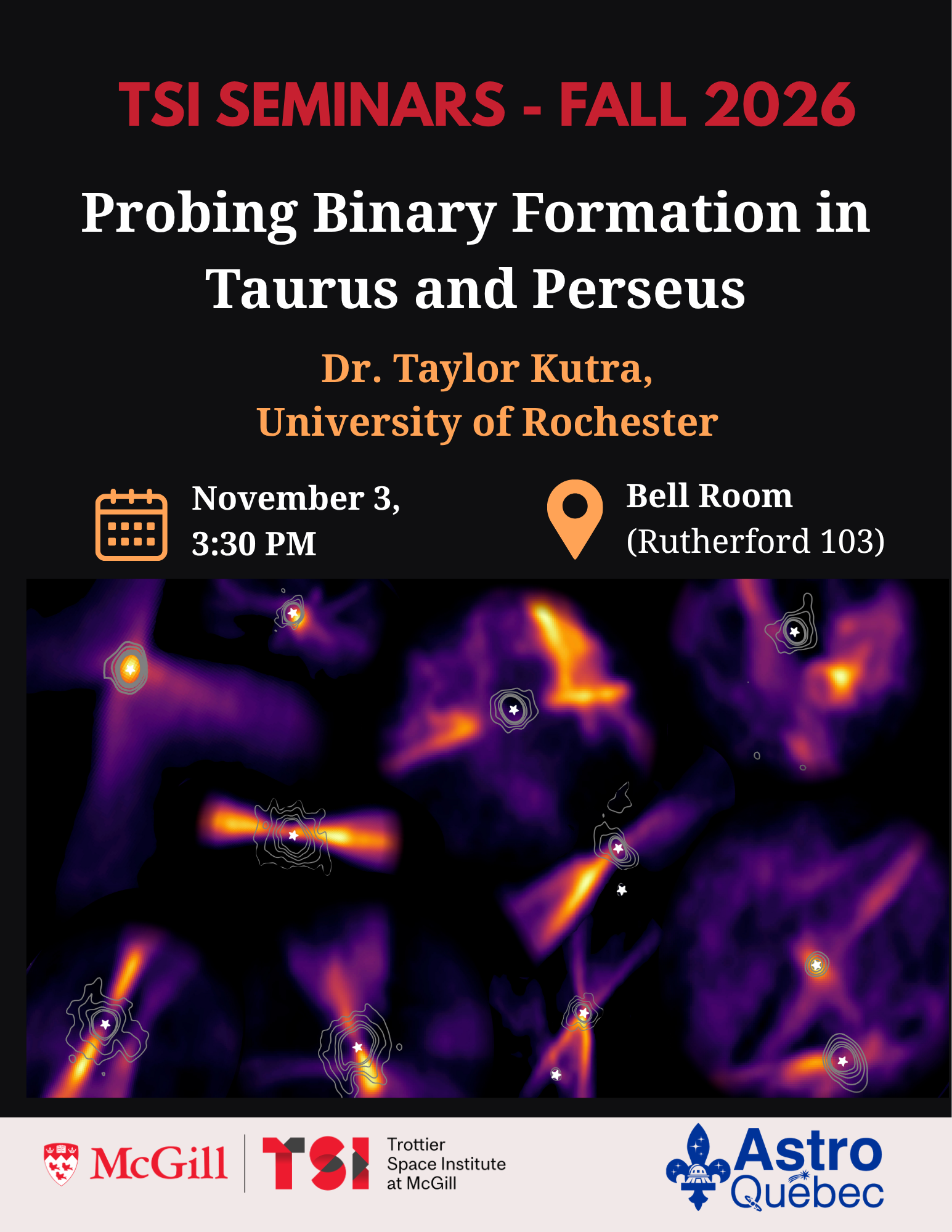
Probing Binary Formation in Taurus and Perseus
Taylor Kutra
(University of Rochester)
Nov 3, 2026 3:30 PM
to 4:30 PM
Location: Bell Room (Rutherford 103)
Seminar Event
The dominant mechanism by which binary stars form remains uncertain, particularly for systems with separations of 50–1000 au where both disk fragmentation and core fragmentation may operate. These formation pathways can produce different orbital and circumstellar orientations, making the mutual obliquities of binary orbits, circumstellar disks, and protostellar outflows valuable probes of binary formation. In this talk, I will present two observational programs which characterize these orientations at different stages of star formation. The first targets circumstellar disks in close (<50 au) Taurus binaries, combining ALMA observations with astrometric orbits to constrain both disk-disk and disk-orbit obliquities. The second uses observations from the PRODIGE (PROtostars and DIsks: Global Evolution) survey on NOEMA to constrain the orientations of Class 0 protostars through their molecular outflows. Together, these programs explore how measurements of three-dimensional orientations can help distinguish between binary formation pathways, from the earliest protostellar stages to more evolved young systems.
More
about Taylor Kutra
⇒