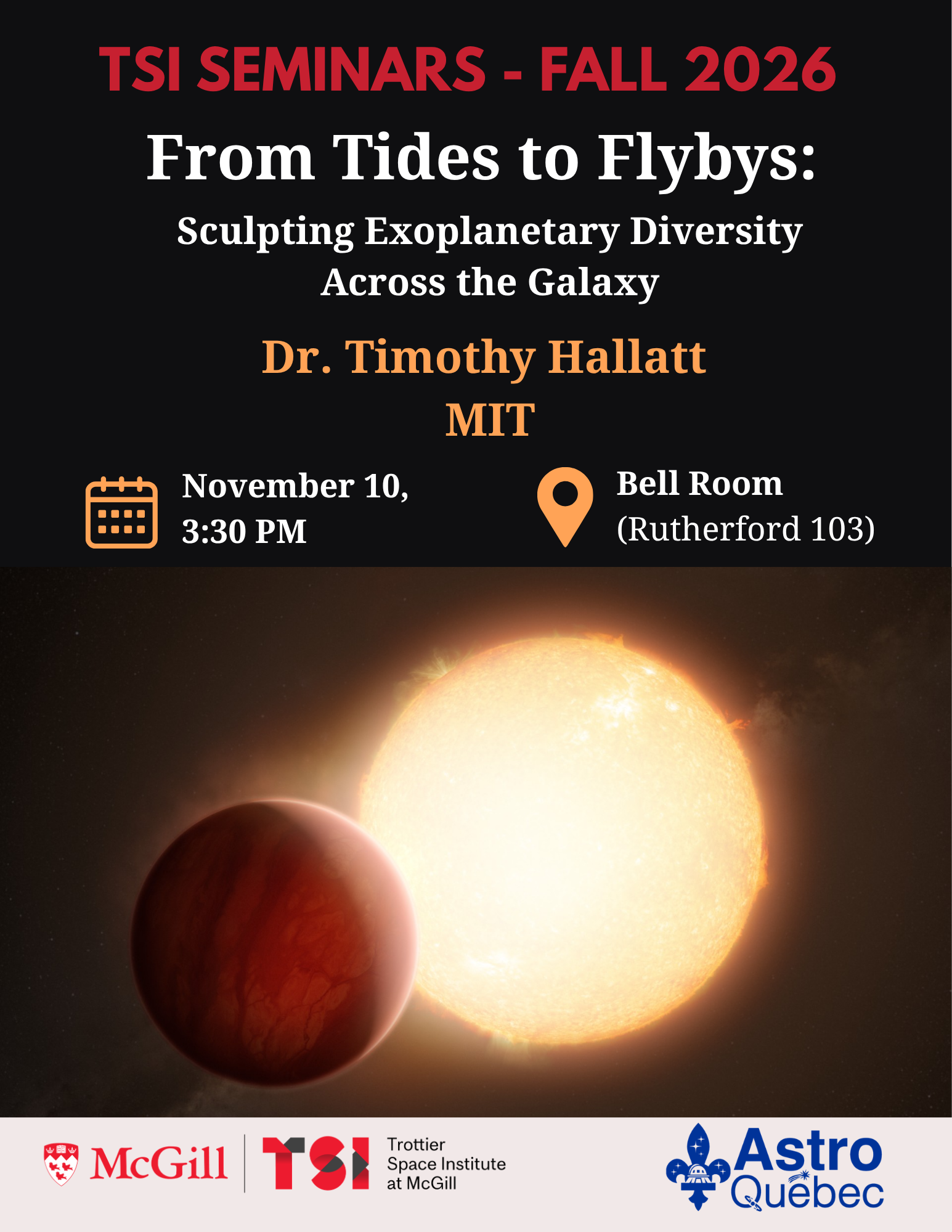
From Tides to Flybys: Sculpting Exoplanetary Diversity Across the Galaxy
Timothy Hallatt
(MIT)
Nov 10, 2026 3:30 PM
to 4:30 PM
Location: Bell Room (Rutherford 103)
Seminar Event
Exoplanet surveys have revealed that planets come in a remarkable variety of sizes and orbital configurations that have no counterpart in the Solar System. Despite tremendous observational progress characterizing planetary system diversity, our theoretical understanding of the origin of this diversity remains highly incomplete; first-order questions remain mysterious and largely unsolved (What are planets’ compositions? How did their orbits come to be?). This talk will outline how ongoing measurements and theory can be used to infer the fundamental physical processes sculpting such exoplanetary diversity across the Galaxy. First, I will demonstrate how tidal physics continues to reshape planetary systems (and planets themselves) over billions of years. Specifically, I will outline how the tidal destruction of hot Jupiters may allow us to directly study the interiors of gas giants, which are otherwise inaccessible to telescopic observation. I will then turn to hot Jupiters' enigmatic cousins, hot Neptunes, and highlight how their orbital architectures encode the physics governing planetary migration. I will close by illustrating how upcoming observations from the newly launched Roman Telescope will allow us to constrain a fundamentally new driver of planetary system diversity: the Galactic environment.
More
about Timothy Hallatt
⇒