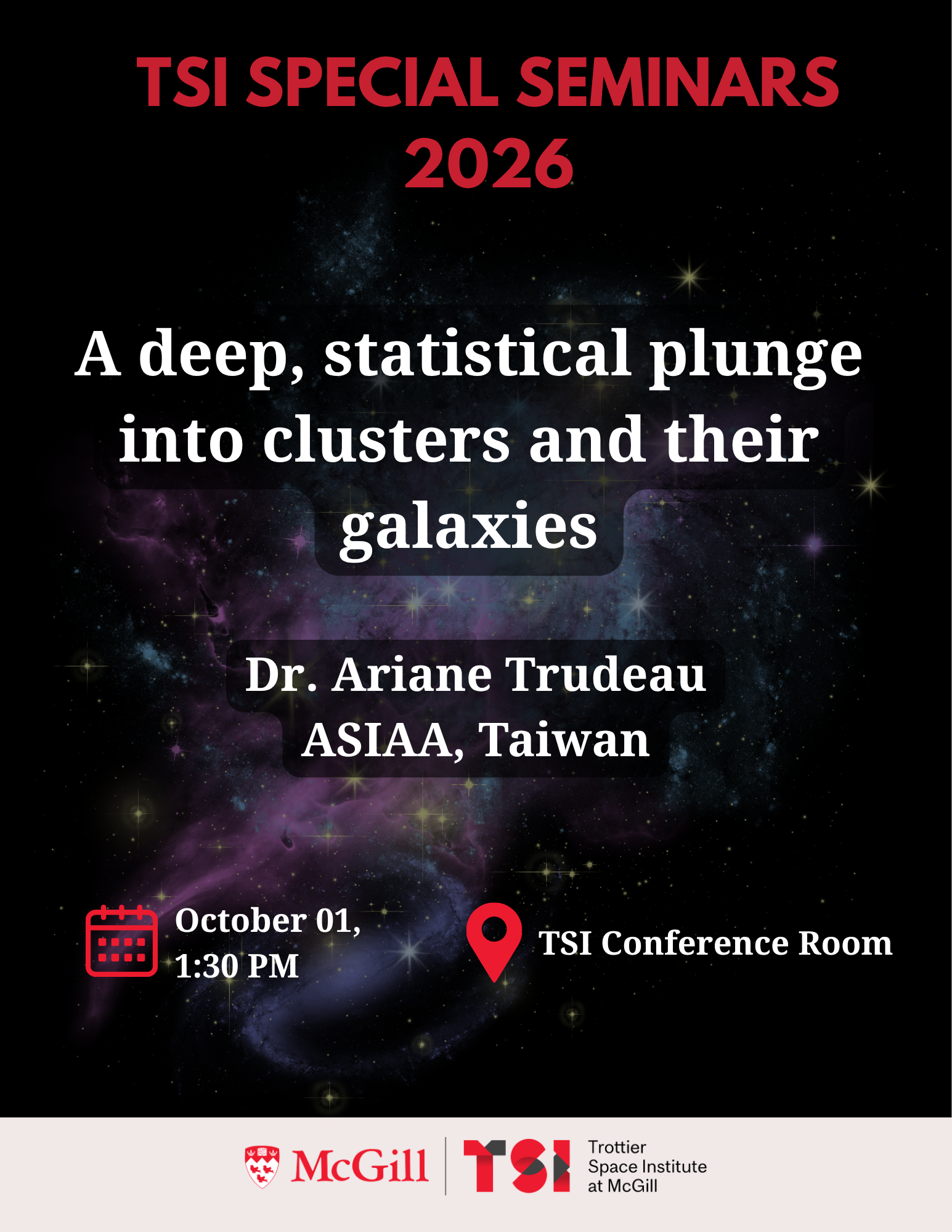
Special Seminar: A deep, statistical plunge into clusters and their galaxies
Ariane Trudeau
(ASIAA, Taiwan)
Oct 1, 2026 1:30 PM
to 2:30 PM
Location: TSI Conference Room
Seminar Event
Galaxy clusters are massive structures made of dark matter, hot gas and galaxies that grow through the accretion of smaller systems. Dense environments such as these tend to prematurely shut down star formation in member galaxies. In this presentation, I explore the link between the cluster environment and member galaxies using a statistical technique called total light stacking. I first examine the star formation activity of 10 000 groups and clusters as a function of clustercentric distance and redshift, showing that before z~1.5, the environment does not impact star formation. I then use 83 000 clusters to demonstrate that total light stacking can be used to detect the splashback radius, a physical boundary between the cluster and the surrounding infalling regions. I finally present a proof of concept of the potential of total light stacking to investigate the star formation history of the cluster infalling region, showing that the fraction of the stellar mass in this region increases with increasing redshift.
More
about Ariane Trudeau
⇒